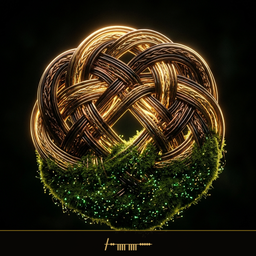
The Plain Facts, Carved
What It Is
An Arduino experiment, woven — wire and thread instead of PCB and breadboard. The circuit is not housed but plaited: conductive paths laid in the weave, the components worked into the braid like beads into hair.
Weaving is an old word for what circuits do anyway — a track crossed at intervals by another, held under tension, the whole pattern decided before the first thread. The Arduino in this one animates the braid: light and sensing carried by the cloth itself.
It exists because e-textiles are the oldest electronics that were ever wearable, and because the bench wanted to know what happened when the circuit and the cloth were the same object.
Told in the Seanchaí Tradition
The Build Story
At Bealtaine and at Imbolc, in the old houses, the women plaited — rushes into crosses, thread into crios belts, straw into harmony knots — and the pattern was never decoration, it was ward: the plait as protection, the interlacing as a way of holding a thing closed against whatever the season sent. A crossing is a promise. When the bench in 2013 decided to plait a circuit, it was doing this old work in a new material: the wire is a rush that happens to conduct, the weave is a cross that happens to compute, and the Arduino animates the ward — the plait not just holding the dark out but answering to it, which no rush cross ever managed. The old craft would have called that an upgrade, not a sacrilege: the purpose of a weave is to keep, and a weave that keeps and speaks keeps better. Cross the threads, says every plait ever made in a season of need. Tension, tension, hold — and whatever comes, the pattern is what survives you. The moss grows on this stone exactly like moss on a well-worked basket: in the grooves, following the plait, in on itself.